


Amazon can break a winning listing without warning. A suppressed ASIN, lost Buy Box, or silent content edit can drain sales and create revenue leaks before anyone spots the problem in Amazon Seller Central.
That is why Amazon listing monitoring tools matter for proactive account health. The strongest AI-powered tools do more than ping you. They show what changed, how fast it changed, and what your team should fix first, making monitoring a critical part of your listing optimization strategy.
If you are comparing options in 2026, start with the tools built for fast error response.
Key Takeaways
- Amazon listing monitoring tools deliver instant, customizable alerts for suppressed ASINs, Buy Box losses, price changes, listing edits, and competitor moves to prevent revenue leaks and support proactive account health.
- Top options like SellerSonar excel for brands with broad catalog protection, SellerMagnet Alerts integrate seamlessly in suites for fast fixes, while SentryKit specializes in Buy Box and margin context.
- Dedicated monitors outperform broader suites (e.g., Helium 10) in alert clarity and speed, but choose based on workflow fit, marketplace coverage, and plan limits.
- Test tools for alert latency, detail (ASIN, issue type, impact), filtering, and actionability to ensure teams can fix problems in minutes.
Top Amazon listing monitors compared
This quick table focuses on alert coverage including buy box tracking and price monitoring, automated alert speed signals, and fit.
| Tool | Best fit | Core alerts | Speed signal | Pricing note |
|---|---|---|---|---|
| SellerSonar | Brands and agencies seeking brand protection with large catalogs | Listing edits, suppressions, buy box tracking, price monitoring, reviews, competitor moves | Instant, customizable automated alerts | Varies by plan |
| Bindwise | Sellers focused on brand protection, listing, and account health | 404 pages, detail page changes, fees, store issues | Continuous API-based monitoring with automated alerts | Varies by account |
| SellerMagnet Alerts | Sellers who want monitoring inside a wider suite | Unauthorized sellers, buy box tracking, listing changes, fee shifts, inventory, reviews | Continuous scanning, instant automated alerts | Included in SellerMagnet dashboard |
| SentryKit | Brands centered on buy box tracking and margin protection | Buy box tracking, competitor moves, listing health, price monitoring, inventory, badges | Full-context automated alerts across catalog | Check current plans |
| AmzMonitor | Teams tracking ASINs, sellers, and keywords together | Listing changes, suppressions, unauthorized sellers, reviews, rank shifts | 24/7 surveillance with automated alerts | Check current plans |
The field splits into two camps. Some tools focus on broad catalog health. Others care most about buy box tracking pressure and competitor movement. Pricing and feature depth can also change by plan, ASIN count, user seats, and marketplace, so verify current terms before you buy.
If you manage several markets, plan limits matter almost as much as features. A low-cost tier with delayed alerts or tight ASIN caps can end up costing more than a higher plan that catches problems early.
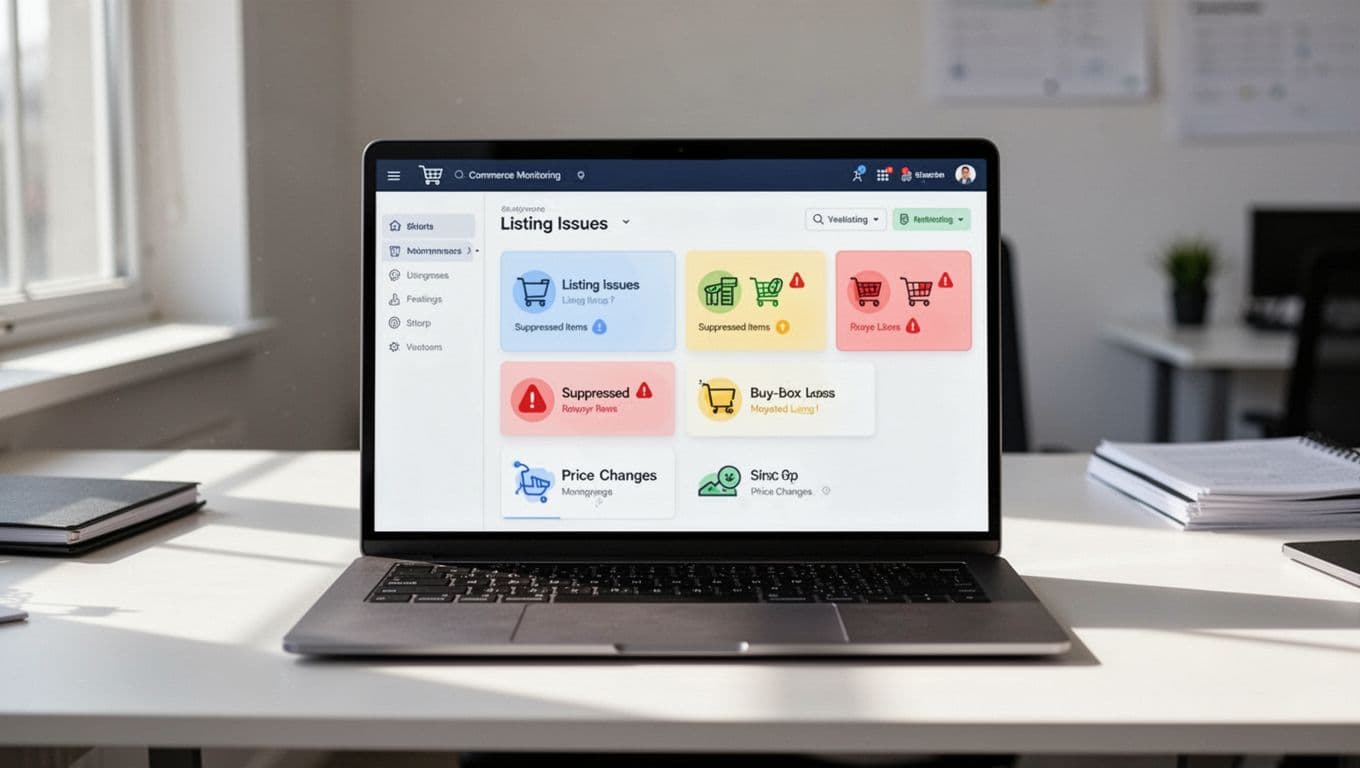
For most teams, SellerSonar and SellerMagnet Alerts look strongest for quick, multi-signal marketplace intelligence. Bindwise is a good fit when listing errors connect to wider account risk. SentryKit is more specialized around buy box tracking context, while AmzMonitor adds keyword and seller tracking for teams that want one watchlist. Also look at reporting depth, because managers need clean summaries, while catalog teams need event-level history.
Which tools are strongest for fast error alerts
When a listing goes suppressed at lunch and nobody sees it until evening, the lost sales are obvious. The harder cost is slow diagnosis across teams.
A fast alert is more than a timestamp. It should name the ASIN, the marketplace, the issue type, and the likely impact. Otherwise, it is like a smoke alarm with no room number.
The best alert is the one your team can act on in minutes.
SellerSonar is one of the more balanced options. It offers instant, customizable alerts for price changes, Buy Box shifts, new reviews, suppressions, listing edits, and competitor movement. Because it also tracks keywords and competitors through keyword research, agencies can connect an alert to ranking or traffic changes without bouncing between tools.
SellerMagnet Alerts wins on setup and delivery. Its current product page says it uses ai-powered tools to scan continuously, supports Amazon Seller Central SP-API setup in minutes, and can send instant notices through in-app messages, email, or Discord. It also watches fee shifts and inventory drops, connecting seamlessly to ppc management and inventory management in one dashboard for faster fixes than the standard seller app.

Bindwise takes a more defensive angle with map enforcement. It uses Amazon API data in a read-only model and flags problems like 404 dog pages, content modifications, fee issues, and store-level alerts. That makes it a strong choice for sellers who care about compliance, listing health, and catching account-wide trouble before it grows.
SentryKit looks at the same problem through a Buy Box lens. It monitors Buy Box status, competitor moves, pricing, listing health, badges, inventory, and sales signals across the catalog. The extra value is context. If another seller changes price or fulfillment and your Buy Box drops, the alert is more useful when it tells you why margin or revenue may move next.
AmzMonitor fits teams that want catalog monitoring plus keyword rank watching. Its product page emphasizes 24/7 ASIN surveillance for suppressions, hijackers, review changes, and other content modifications. If review swings or content changes often affect conversion rates on your hero ASINs, having those alerts beside keyword movement can shorten triage.
Dedicated monitors vs broader seller suites
Some of the biggest Amazon software names in 2026, including Helium 10, Jungle Scout, SmartScout, ZonGuru, and DataHawk, all offer some form of monitoring. Their strength is breadth. You get product research, keyword research, listing optimization, profitability, SEO, and catalog data in one login, often powered by web scraping and browser automation to collect public listing data.
Still, their monitoring depth is not equal. Current 2026 positioning suggests helium 10 is the strongest all-around suite for alerts, with listing protection, Buy Box visibility, and index checks inside a larger stack that includes sales estimator, asin tracker, retail media, ppc management, and multi-channel selling tools. SmartScout excels in competitor analysis, while jungle scout is easier for newer sellers with strong product research and keyword research but less focused on sudden catalog errors. ZonGuru and DataHawk lean more toward visibility and keyword or index monitoring, plus inventory management.

Dedicated Amazon listing monitoring tools usually win on alert clarity. They are built to catch suppressed listings, a+ content edits, Buy Box loss, price anomalies, review changes, and inventory warnings with less noise. Broader suites win when you also want product research, keyword research, and listing optimization in the same budget.
Workflow fit matters as much as features. Email alerts are fine for solo sellers, but agencies and brand teams need routing, ownership, and change history. Tools bundled with analytics or repricing can reduce handoffs, while dedicated monitors often make the first fix easier to spot. Also check marketplace coverage, because pricing and features can shift across regions and plan tiers.
Before you choose, test three things in a trial. First, measure alert latency on a known change. Next, check whether you can filter alerts by ASIN or marketplace. Finally, confirm that the alert includes enough detail for the first fix, because a noisy dashboard slows teams down almost as much as no alert at all.
Frequently Asked Questions
What are the top Amazon listing monitoring tools in 2026?
SellerSonar leads for brands and agencies with instant alerts on edits, suppressions, Buy Box, prices, and competitors. SellerMagnet Alerts offers continuous AI scanning integrated with PPC and inventory tools, while SentryKit focuses on Buy Box context and Bindwise on account-wide compliance like 404s and fees. AmzMonitor adds keyword and seller tracking for comprehensive surveillance.
Dedicated monitors vs. broader seller suites—which is better?
Dedicated tools like SellerSonar win on alert speed and clarity for sudden errors like suppressions or Buy Box drops with less noise. Broader suites such as Helium 10 provide monitoring alongside research and optimization but may lack depth in real-time catalog health. Pick dedicated for error response or suites if you need one-login breadth.
How do I choose the right monitoring tool for my team?
Assess your pain points: broad catalog health, Buy Box pressure, or competitor moves. Test alert speed on known changes, check for ASIN/marketplace filtering, and ensure context like impact details for quick fixes. Factor in pricing by ASIN count, seats, and marketplaces, plus integrations for workflow efficiency.
Why are fast, contextual alerts critical for Amazon sellers?
Silent issues like suppressed listings or Buy Box losses drain sales before Seller Central notice. Effective alerts name the ASIN, marketplace, issue, and fix priority, enabling minute-by-minute action over generic pings. This cuts diagnosis time and ties monitoring to listing optimization for growth.
What should I test in a tool trial?
Measure alert latency on a test change, verify filtering by ASIN or market, and confirm detail for first fixes like impact estimates. Check setup ease, delivery options (email, app, Discord), and reporting for teams. Run on high-risk ASINs to gauge speed and context before committing.
Final thoughts
Fast automated alerts only help when the signal is clear and the team can act right away. For most sellers, the best fit depends on what breaks most often, broad catalog health, Buy Box pressure, or a mix of both informed by competitor analysis.
This leads to data-driven decisions that drive listing optimization and sustained growth.
Run a short pilot on your highest-risk ASINs and watch for speed plus context. If the tool catches changes within minutes and tells your team what to fix, it is worth keeping.