

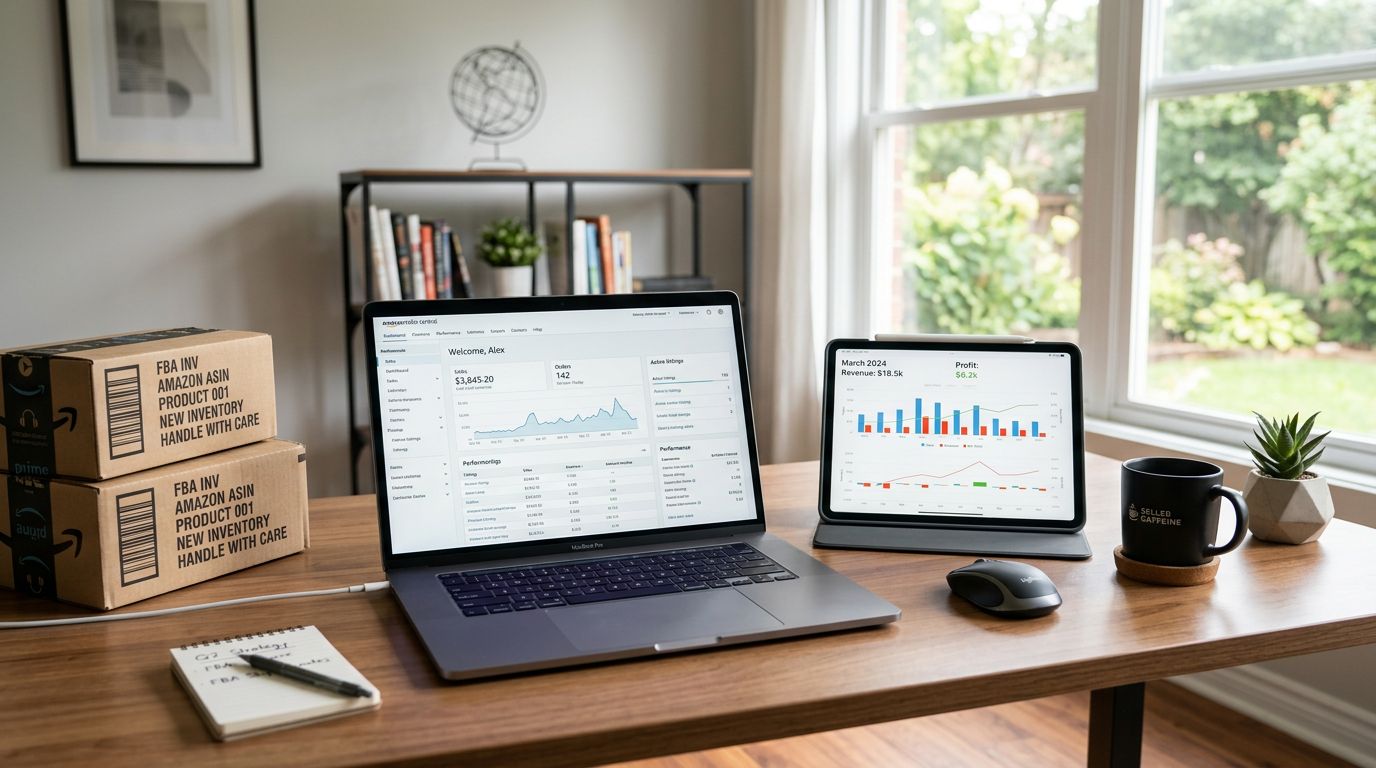
Starting amazon fba in 2026 is less like striking gold and more like packing for a long trip. If you bring the right gear (docs, numbers, and a plan), you’ll feel steady. If you wing it, small fees and small mistakes stack up fast.
This guide walks you from account setup to your first two weeks of selling. You’ll also get a simple way to pick a first product, plus profit math you can reuse on every item.
Step 1: Set up your seller account the right way (and avoid compliance headaches)
Before you buy anything, lock down your seller account. Amazon cares about identity, traceable supply, and safe products. That’s true in the US, UK, CA, and AU, even if the exact tax flow and category rules differ.
In 2026, your first decision is account type:
- Individual: no monthly fee, but you pay $0.99 per item sold (better for very low volume).
- Professional: $39.99 per month in the US (pricing varies by marketplace), no per-item fee, and it’s the common choice once you’re serious.
Next, gather your setup paperwork. This mini-checklist keeps sign-up smooth:
- Government ID (passport or driver’s license)
- Proof of address (typically within the last 180 days)
- Bank account for payouts
- Credit card that supports international charges
- Tax details (SSN/EIN in the US, local equivalents elsewhere)
- Phone number for verification
Then complete the basic flow in Seller Central: personal and business info, identity checks (upload plus selfie or video), bank and tax interview, then marketplace selection. If you want a walkthrough with screenshots, see this end-to-end seller account setup guide.
If your documents don’t match (name, address format, outdated statements), verification can stall. Fix that before you click submit.
Finally, decide how you’ll operate: personal name, sole prop, or LLC. Many beginners start simple and formalize once they prove demand. If you sell in multiple countries, also plan for currency conversion costs and VAT or GST registration triggers.
Step 2: Choose a first product using a simple “survive the fees” filter
A first product should be boring in the best way. Small, durable, and easy to describe. In 2026, fees, returns, and ads punish weak items. So your product must survive real costs, not best-case math.
Use this quick decision framework:
- Demand: aim for at least 30 sales per month and a sales rank that suggests steady movement (a common starter filter is under 200,000 in many categories).
- Profit room: target $3+ profit per unit after all costs, and 30%+ ROI (profit divided by total unit cost).
- Price sweet spot: many beginners do well in the $15 to $85 range. Too cheap leaves no margin, too expensive slows conversion.
- Weight and size: aim for under 1 lb to keep fulfillment and shipping costs manageable.
- Risk: avoid fragile items, liquids, products with moving parts, and anything that creates safety or compliance risk.
Here’s a quick comparison to sanity-check your shortlist:
| Factor | Usually a good first product | Usually a risky first product |
|---|---|---|
| Size/weight | Small, under 1 lb | Bulky, heavy, oversize |
| Build | Durable, few parts | Fragile, many pieces |
| Compliance | Simple, non-regulated | Topicals, ingestibles, kids safety items |
| Differentiation | Clear improvement (bundle, material, instructions) | Same as everyone else |
If you want a broader checklist format to compare against, this Amazon FBA checklist for 2026 is handy for making sure you didn’t skip a key setup step.
One more risk rule: don’t order 1,000 units first. Start with 50 to 100 units (or even less) so you can see real fees, real returns, and real ad costs.
Step 3: Calculate Amazon FBA profit (with a formula you can reuse)
Most beginners lose money for one reason: they calculate profit like a guess, not like a system.
Use this formula for net profit per unit:
Net Profit = Selling Price – (COGS + FBA fees + referral fee + ads + returns + storage + inbound and misc.)
And use these two simple health checks:
- Margin % = Net Profit ÷ Selling Price × 100
- ROI % = Net Profit ÷ (COGS + inbound) × 100
In 2026, remember three cost realities:
- Amazon charges a referral fee (often 8% to 15%, depending on category).
- FBA fulfillment fees increased in 2026 (one widely reported change is an average +$0.08 per unit for many standard-size items in the $10 to $50 range, but your exact fee depends on size tier and marketplace).
- Returns and storage are not “rare events.” Budget for them from day one.
This example is illustrative, but it shows why “looks profitable” often isn’t:
| Line item (per unit) | Amount |
|---|---|
| Selling price | $25.00 |
| COGS (product + getting it to Amazon) | -$10.00 |
| Referral fee (example 15%) | -$3.75 |
| FBA fulfillment fee (example) | -$6.50 |
| PPC ads (example) | -$1.50 |
| Returns allowance (example) | -$0.60 |
| Storage (averaged) | -$0.20 |
| Net profit | $2.45 |
That’s under 10% margin. It’s not a crime, but it’s hard to grow.
To avoid guessing, run every product through a fee tool before you buy inventory. This Amazon FBA fees calculator guide explains what to model and how fee changes affect the unit level.
If you can’t hit 30% margin on your first product, you’re buying stress, not a business.
Step 4: Source, prep, ship, then launch with a minimum viable 14-day plan
Once the math works, execution matters. This is where amazon fba gets real.
Source like a skeptic (not like a shopper)
Start by requesting samples, confirming materials, and getting everything in writing. Your first goal is consistency, not perfection.
Mini-checklist before you place a paid order:
- Confirm packaging (units per case, poly-bag rules, suffocation warnings if needed).
- Confirm labeling (FNSKU label placement, scannable barcode).
- Ask about lead times and what happens if units arrive defective.
- Keep invoices and supplier contact info organized (you may need them for authenticity checks).
Prep and labeling changed in 2026
A key operational change: Amazon ended FBA prep and labeling services in 2026 (US impact is widely discussed, and other marketplaces may vary). That means you must prep and label yourself or use a third-party prep center.
Also plan for inbound placement rules. Amazon may split your shipment across fulfillment centers, and choosing “ship everything to one place” can trigger extra placement-related costs.
For background on the 2026 cost pressure, see this summary of Amazon FBA fee changes in 2026.
Build a listing that’s clear, compliant, and conversion-focused

Photo by Tobias Dziuba
Focus on basics: a clean main image, specific titles, honest bullets, and a simple comparison in your images. Don’t promise outcomes you can’t prove. Stay away from restricted claims (especially in topical, supplement, and wellness-adjacent categories).
Minimum viable launch plan (first 14 days)
Use this plan to get signals fast without burning cash.
| Days | What to do | What “good” looks like |
|---|---|---|
| 1 to 2 | Create listing, set price, send inventory (or switch to FBA once received) | Listing is complete, no suppressed content |
| 3 to 5 | Start ads with a tight daily cap, test 5 to 15 keywords | Some impressions, a few clicks, no runaway spend |
| 6 to 7 | Improve images and bullets, add a small coupon if needed | Conversion improves, questions drop |
| 8 to 10 | Watch returns, search terms, and PPC waste, pause bad keywords | ACoS stabilizes, fewer irrelevant clicks |
| 11 to 14 | Reorder decision: only reorder if margin holds after ads and returns | You can fund the next batch without panic |
Keep your ad budget controlled early. Also check inventory age and storage exposure, because slow movers can turn into fee magnets.
Conclusion
Starting amazon fba in 2026 works best when you treat it like a process, not a lottery ticket. Set up your account cleanly, pick a product that survives real fees, and run profit math before you buy. Then launch small, measure fast, and reorder only when the numbers stay solid. What product could you test with 50 units and still sleep well at night?