


Fast shipping loses its shine when stock is wrong or orders route to the wrong place. If you run Shopify, Walmart, and DTC channels from Amazon inventory, the weak spot is rarely the warehouse. It’s the software between your storefronts and MCF.
In 2026, Amazon made Multi-Channel Fulfillment more attractive with new pricing incentives, even as base fees moved up for many orders. That puts more pressure on tooling, because the right app can protect margin while keeping delivery promises tight. The buying decision starts with one question: do you need a light connector, or a true order layer?
What good Amazon MCF software needs to handle
At a minimum, solid Amazon MCF software should do five jobs well. It should sync inventory in near real time, route orders to Amazon without manual exports, map shipping speeds correctly, push tracking back to the original channel, and flag exceptions before they become support tickets.
Because MCF pricing changed in 2026, fee visibility matters more than it did a year ago. Brands now need software that helps them choose the right service level and avoid expensive surprises on low-margin orders. A current overview of 2026 MCF fee changes is useful context before you compare apps.
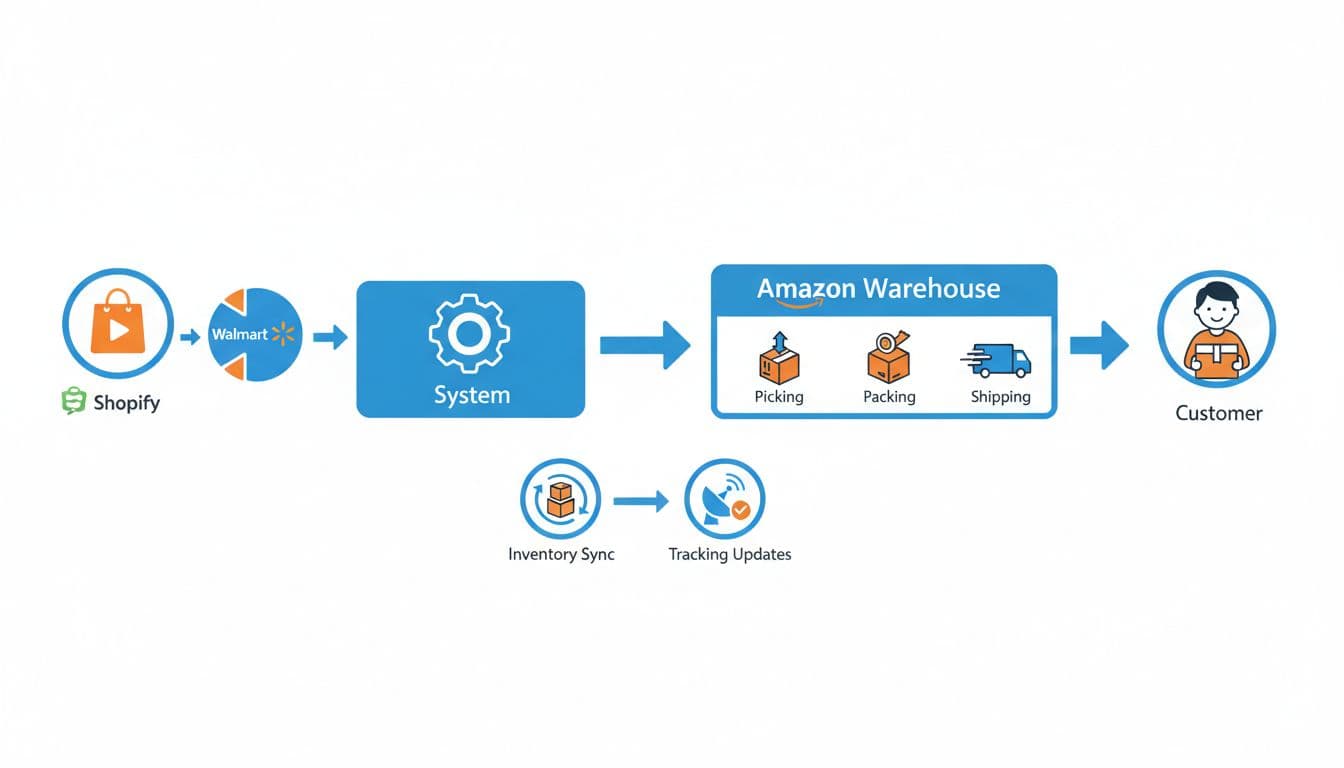
The next layer is where tools start to separate. Better systems handle channel-specific rules, promised delivery windows, bundle logic, and hybrid routing when Amazon is out of stock. They also reduce bad data. That means fewer duplicate SKUs, fewer stale counts, and fewer “why did this ship Priority?” moments.
MCF is strong at shipping orders. It is weaker at acting like a full order brain.
So, if your operation is simple, a dedicated connector may be enough. If one order might go to Amazon today and a 3PL tomorrow, you are already moving toward OMS territory.
The top Amazon MCF software picks for 2026
This quick table shows where each tool fits best.
| Tool | Best for | Core strength | Pricing approach |
|---|---|---|---|
| Amazon MCF Integrations | Brands wanting a purpose-built connector | Broad channel support and live stock sync | Free tier, then paid plans starting at $19/month, with higher tiers by connector and volume |
| M2E Cloud | Shopify-led brands with marketplace sales | Checkout speed mapping and marketplace sync | App and plan-based pricing, varies by product |
| ByteStand | Shopify brands with bundles or mixed fulfillment | Bundle support and rule-based routing | App-based tiers |
| Veeqo | Cost-aware teams that also need shipping ops | Free inventory and shipping management with MCF support | Free core platform |
The pattern is simple. Dedicated connectors get you live faster, while broader ops tools help more when routing rules get messy.
Amazon MCF Integrations
For most brands, this is the safest direct connector to start with. It is built around Amazon MCF, not around a general OMS pitch. Current product listings and review summaries point to support for Shopify, BigCommerce, WooCommerce, Magento 2, Walmart, eBay, TikTok Shop, Temu, ShipStation, and NetSuite, plus international coverage across major Amazon markets. You can review its pricing and feature breakdown before a demo.
Its strengths are easy to see. Setup is light, inventory sync is a core feature, and it keeps the job focused: push orders to Amazon, return tracking, and reduce oversells. The limit is depth. It is not the right tool if you need sophisticated order orchestration, advanced exception queues, or deep warehouse logic. It is the best fit for small to mid-sized multi-channel brands that want MCF live fast.
M2E Cloud
M2E Cloud is strongest when Shopify is central to the business. Its Shopify Amazon MCF integration maps storefront delivery choices such as standard or expedited to the correct Amazon MCF service level. That matters because checkout promises affect conversion, and bad speed mapping burns both margin and trust.
M2E also makes sense for brands that sell across marketplaces and want tighter listing and catalog control alongside MCF. The trade-off is scope. It is still closer to a commerce connector than a full order platform. If your team needs heavy routing logic across multiple fulfillment nodes, M2E may not go far enough by itself. It is the best fit for Shopify-heavy sellers that want better delivery control without buying a full OMS.
ByteStand
ByteStand is a strong choice for Shopify merchants with more complex catalog rules. Product information from recent app listings highlights virtual bundles, pre-orders, real-time shipping rates and times, and rule-based routing to Amazon MCF or a 3PL. That makes it more flexible than a basic connector.
The limitation is focus. ByteStand is mainly a Shopify answer, so it is less attractive if Walmart, marketplaces, or ERP-driven order flows sit at the center of your stack. Still, it is a smart buy for brands that run subscriptions, bundle offers, or mixed fulfillment models and want those orders to stay inside one Shopify-led workflow.
Veeqo
Veeqo sits one level above a connector. A recent roundup of MCF integrations describes it as a free, Amazon-owned shipping and inventory platform that can route orders from Shopify, eBay, and Walmart into MCF and return tracking details.
That makes Veeqo appealing for lean teams. You get broader daily operations support, not only MCF order forwarding. However, it is still not a deep OMS. Complex routing rules, channel-specific allocation, and heavy exception management can outgrow it. Veeqo is the best fit for operators who want basic multi-channel control without adding new software cost right away.
When Amazon MCF wins, and when it doesn’t
Amazon MCF is a strong choice when delivery speed matters, your catalog is fairly clean, and you already hold inventory in FBA. It is also good when you want one pool of stock serving Amazon, Shopify, and Walmart without opening new warehouses.

This is the quick decision frame most operators use:
| Option | When it makes sense | Main drawback |
|---|---|---|
| Amazon MCF | Fast launch, FBA inventory, strong delivery speed | Less control over branding and routing depth |
| OMS | Many channels and many fulfillment nodes | Needs fulfillment partners behind it |
| WMS | You run your own warehouse | Higher fixed cost and slower setup |
| 3PL | Custom packaging or non-Amazon strategy | Service levels and rates vary a lot |
If you need branded inserts, special kitting, lot tracking, wholesale order logic, or flexible warehouse allocation, MCF alone will feel tight. That is where an OMS, WMS, or hybrid partner comes in. For example, tools such as Crazy Vendor are worth a look when you want rules that can route by channel, SKU, region, or SLA across Amazon, Walmart, a 3PL, or your own warehouse.
Final thoughts
The best Amazon MCF software in 2026 depends on your operating model, not on a feature checklist. If your goal is fast setup and reliable order flow, Amazon MCF Integrations and M2E Cloud are the clearest choices.
As order logic gets harder, Shopify apps like ByteStand and ops layers like Veeqo become more attractive. Once routing, exceptions, and warehouse choice start driving margin, you are no longer buying only an MCF connector. You are choosing how your business will run day to day.