

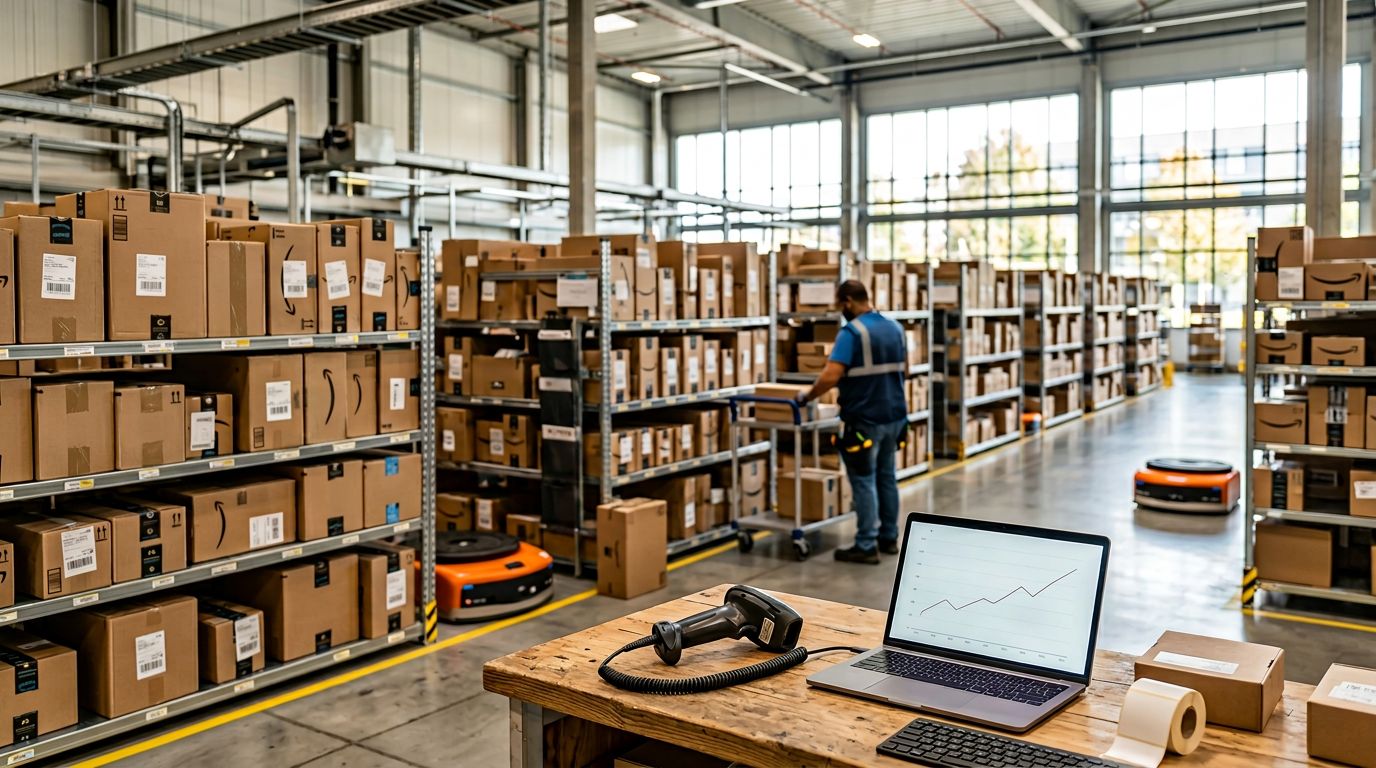
Buying a product in bulk, sending it to Amazon, then letting Amazon ship it to customers sounds almost too simple. The simple part is the shipping. The hard part is everything that comes before it.
Amazon FBA wholesale is a reselling model where you buy already branded products from a manufacturer or authorized distributor, then sell them on Amazon using Fulfillment by Amazon (FBA). You do not create a new brand, and you usually do not create a new listing. Instead, you compete on the same listing as other sellers, aiming to win the Buy Box with strong metrics, fast Prime shipping, and a competitive price.
If you want a business model that feels more like “inventory and operations” than “marketing and branding,” wholesale is often the better fit.
Amazon FBA wholesale, explained in plain English
Think of wholesale like owning a small convenience store, except your shelves are inside Amazon’s warehouses. You purchase inventory at a wholesale price, then resell it at retail prices on Amazon.
Here’s what makes wholesale different from other popular Amazon models:
- Wholesale vs private label: Private label means you create a brand (or at least a branded version of a product). Wholesale means you sell brands that already exist and already have demand.
- Wholesale vs retail arbitrage: Retail arbitrage is sourcing from stores (clearance aisles, big box retailers) and flipping. Wholesale is sourcing from businesses that issue proper wholesale invoices and sell in case packs or bulk.
- Wholesale vs dropshipping: With wholesale, you own the inventory and control prep. Dropshipping relies on a third party shipping to customers, and it can violate Amazon’s dropshipping rules if not done exactly right.
The main upside is demand. With wholesale, you’re usually selling products that already have sales history, reviews, and a known market price. The main downside is competition. If ten other sellers can buy the same product, price wars can happen fast, and margins can get thin.
For an expanded overview of the model and sourcing basics, see this Amazon wholesale explained guide.
How the wholesale FBA workflow works in 2026 (fees, labels, and approvals)
FBA is the engine that makes wholesale scalable. You send inventory to Amazon fulfillment centers, and Amazon handles storage, pick and pack, shipping, returns, and customer service. That’s why many wholesale sellers prioritize small, standard-size products that are easy to prep and cheaper to fulfill.
Photo by Joshua Brown
A few 2026 realities matter a lot for beginners:
First, fees changed again in 2026. Fulfillment fees increased on many size tiers starting mid-January 2026, and even small per-unit bumps can wipe out a thin wholesale margin. Also, the low-inventory fee still exists, so running too lean can add surprise cost.
Second, labeling is less forgiving now. Amazon has been moving away from commingled inventory (where identical units get mixed across sellers). As of 2026, sellers should expect to label units with FNSKU and follow prep rules closely, because inbound defects can lead to delays, extra charges, and account health hits.
If your shipment arrives with poor prep or wrong labels, you can pay unplanned prep fees, wait longer for check-in, and rack up inbound defects. Wholesale is boring when it’s done right, and that’s a good thing.
Third, many products require approval (often called “gating”). In practice, this means Amazon may ask for documentation (usually invoices) before you can sell in a category or brand. Amazon’s own documentation is the best starting point for understanding approvals and restricted products, so keep these handy: Seller Central restricted products guidance and the broader Seller Central policy reference.
Step-by-step: from category choice to your first wholesale order
Wholesale success is mostly a process. The goal is to make that process repeatable.
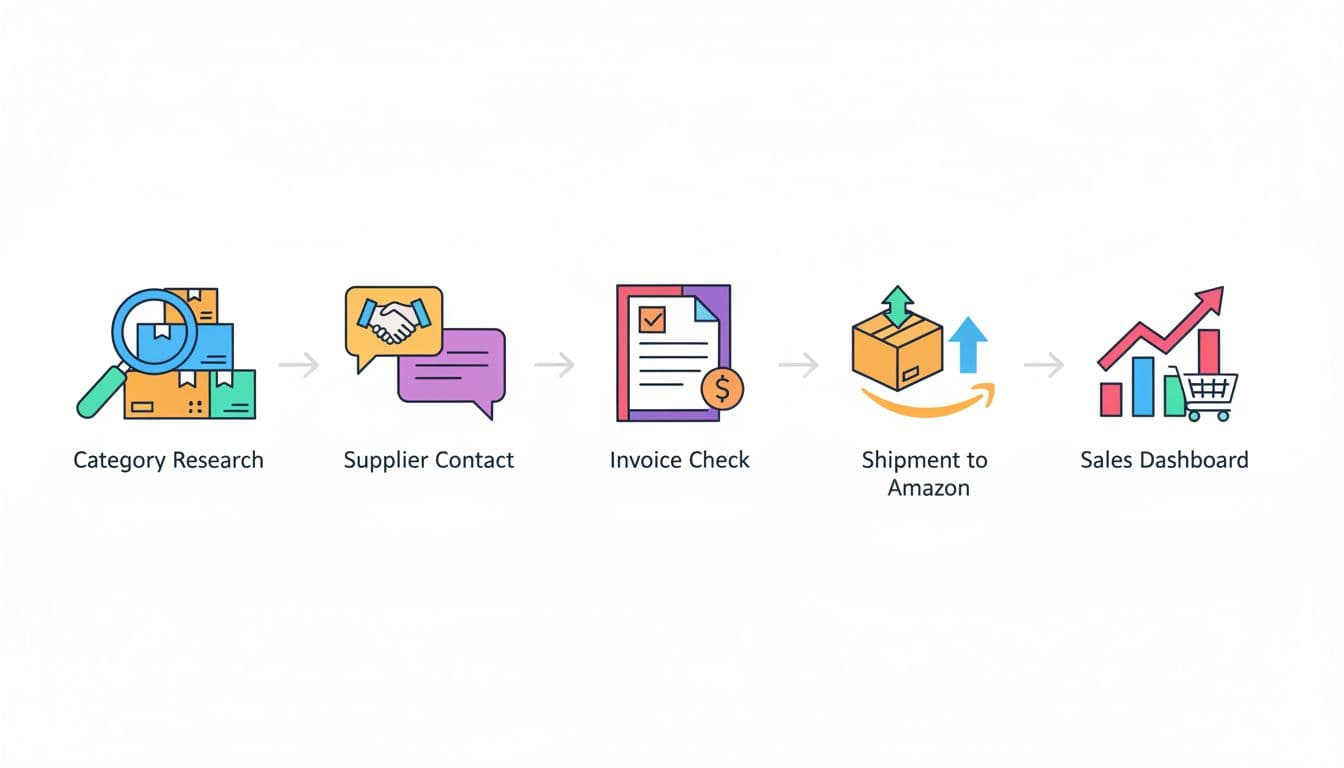
1) Pick a beginner-friendly category (and avoid landmines)
Start with categories that are less restriction-heavy and easier to prep (for many sellers, that’s Home and Kitchen, Tools, or some Toys and Games). Skip anything with expiration dates, ingestibles, topical products, or hazmat until you have experience.
Then, check whether your target products are restricted for your account. If they are, decide early if you’ll pursue approval or choose another product.
2) Build a short list of products worth checking
Don’t fall in love with a product because it “seems popular.” Instead, sanity-check these basics:
- Stable selling price (not constantly crashing)
- Multiple sellers, but not a race to the bottom
- Room for profit after all costs (fees, shipping, prep, returns)
- Low IP risk (no sketchy packaging, no “exclusive” claims)
3) Find real wholesale suppliers (not “lists”)
Look for brand owners and authorized distributors. When in doubt, ask the brand who their authorized distributors are. Also, be cautious with directories and “ungating bundles” that promise too much.
If you want real-world discussions from other sellers, this thread is a useful reality check: Seller Central discussion on verified wholesalers.
4) Vet the supplier before you spend money
A clean invoice and a legitimate supply chain can save your account later.
Supplier vetting checklist (quick but practical):
- Authorization: They confirm they’re the brand or an authorized distributor (ideally in writing).
- Business identity: Website, phone, address, and business registration match up.
- Invoice quality: They can provide an example invoice with full details (not a pro forma).
- Terms and MOQ: Case packs, minimum order, payment terms, and shipping options are clear.
- Returns and defects: They have a policy, and it’s not “all sales final” for damaged goods.
- No red flags: No cash-only deals, no “we can print invoices,” no vague sourcing story.

5) Place a small test order (then prep for FBA correctly)
Your first order should be about learning, not scaling. Buy enough to test sales velocity, refunds, and whether you can consistently win the Buy Box.
Before you order, confirm who handles prep. Since Amazon’s prep expectations are strict in 2026, many sellers either prep in-house or use a proven prep partner.
Invoice requirements checklist (common reasons approvals get denied):
- Correct buyer name and address: Must match your Seller Central legal entity.
- Dated recently: Many approvals expect invoices within a recent window (often within 180 days, but it can vary).
- Supplier details included: Company name, address, phone, and website.
- Line-item detail: Product names, quantities, and unit costs, ideally matching identifiers (UPC, model).
- Not a receipt or pro forma: Needs to be a proper wholesale invoice.
- Enough quantity: Some approvals expect 10+ units per item (varies by category and brand).
Once the order arrives, label each unit (typically with FNSKU), create the shipment in Seller Central, and send inventory to Amazon.
A realistic profit example (with numbers) plus risks to watch
The math is where beginners either build confidence or get surprised.

Let’s say you find a branded household item that sells for $24.99 and fits a standard-size tier.
Here’s a simplified per-unit estimate (use Amazon’s revenue calculator for exact fees by size and weight):
| Item | Amount (per unit) |
|---|---|
| Sale price | $24.99 |
| COGS (wholesale cost) | $9.25 |
| Inbound shipping to FBA (avg) | $0.65 |
| Prep and labels (avg) | $0.30 |
| Amazon referral fee (15% typical) | $3.75 |
| FBA fulfillment fee (example estimate) | $4.60 |
| Estimated net profit | $5.44 |
If you buy 120 units, your cash outlay for product is $1,110. Add inbound shipping and prep (about $114 total), and you’re around $1,224 invested. Selling through all units at the same price yields about $653 net profit, or roughly a 53% ROI on that inventory cash (profit divided by inventory-related costs). That ROI sounds solid, yet it can shrink fast if the price drops by $2 or fees jump due to a size-tier mistake.
Now the part that doesn’t fit neatly in a spreadsheet:
Amazon wholesale risks to take seriously
- Price competition: Another seller can tank the price overnight. Set buy rules and stick to them.
- IP complaints: Even authentic inventory can trigger a complaint if your paperwork is weak.
- Account health hits: Inbound defects, authenticity complaints, and listing policy issues add up.
- Cash-flow pressure: Wholesale ties up money in inventory. Late check-ins or slow sales hurt.
- Approval changes: A listing that was open can become restricted later, so keep invoices organized.
Amazon compliance checklist (2026-focused):
- Use FNSKU labels when required, don’t assume commingling will save you.
- Follow prep rules for polybags, bundles, sets, and fragile items (category rules vary).
- Keep invoices accessible for at least two years, and store supplier emails too.
- Respect brand rules like MAP (minimum advertised price) when you agree to them.
- Watch inventory levels to avoid low-inventory fee surprises and stockouts.
For more on how sellers are thinking about supplier verification right now, this forum thread is worth skimming: how sellers vet distributors in 2026.
Conclusion
Amazon FBA wholesale is simple to explain and demanding to execute. When you source from legitimate suppliers, keep clean invoices, and respect FBA prep rules, you can build a repeatable business on proven products. Start small, track your true costs, and protect your account like it’s your storefront, because it is. If you had to pick one focus for your first month, make it supplier quality.