

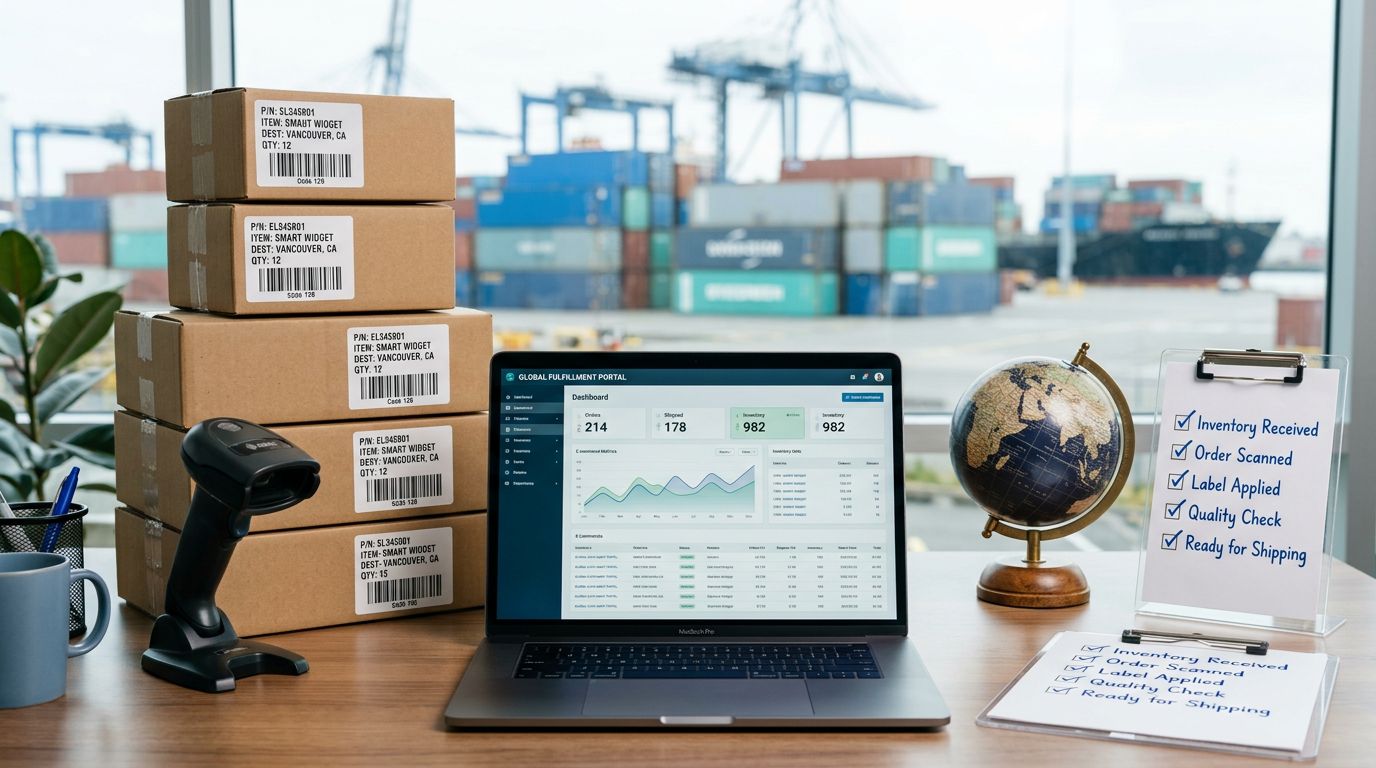
Finding amazon fba suppliers in 2026 isn’t hard. Finding suppliers you can trust, pay safely, and stay compliant with is the real work.
One missing invoice detail, one incorrect barcode, or one loose claim about “certified materials” can turn a good product into stuck inventory. So the goal isn’t “get a supplier fast.” It’s to build a short list of suppliers that can support your Amazon account for years.
This guide shows where to find suppliers, how to vet them like Amazon will, and how to place a first order without betting the farm.
Where to find amazon fba suppliers in 2026 (and what each source is best for)
Supplier hunting works better when you match the source to your business model. Private label needs manufacturers. Wholesale needs brand-authorized distribution. Retail arbitrage is different, but it still benefits from invoice discipline and product safety awareness.
Here are the sourcing lanes that still work well in 2026:
Verified wholesale directories and distributor networks. These are useful when you want invoices that look “Amazon-clean” and you don’t want to chase factories. A long-running example is Worldwide Brands wholesale directory, which focuses on verified wholesalers and dropshippers. Even if you don’t use a directory long-term, it’s a fast way to understand how legitimate wholesalers present themselves.
B2B marketplaces (global and regional). Alibaba, 1688 (China domestic), and regional B2B networks can be strong for private label and packaging customization. The catch is due diligence. Many listings are trading companies, not factories.
Domestic manufacturers and local distributors (US, UK, EU). Margins may be tighter, but communication and shipping speed can save you. Also, compliance documents are often easier to obtain and verify.
Trade shows and industry associations. If you sell in a regulated niche (baby, food contact, electronics), in-person sourcing helps. You can ask document questions face-to-face and avoid suppliers who dodge details.
Modern 2026 shortcut: start from competitors. Pull the top listings in your niche, note brand names, then search for “brand + authorized distributor” and “brand + wholesale.” You’re building a legal chain of custody, not a mystery supply chain.
Screen suppliers for Amazon compliance before you negotiate price
In 2026, cheap product costs can hide expensive compliance problems. Treat compliance like a filter, not an afterthought.
If a supplier can’t give you clean paperwork up front, they won’t magically produce it when Amazon asks.
Invoices and letters of authorization (LOA) for ungating and authenticity
If you plan to sell in restricted categories or branded wholesale, your supplier must produce invoices that match Amazon’s expectations (your business name and address, supplier name and address, itemized SKUs, quantities, dates, and unit costs). Some brands also require an LOA or reseller agreement, especially when MAP (minimum advertised price) is enforced.
If you’re new to restrictions, read a current ungating walkthrough, then build your supplier requirements around it. This 2026 ungating guide is a solid reference for the kind of documentation sellers get asked for.
GS1 barcodes and FNSKU labeling (now that prep is on you)
In 2026, barcode mistakes still cause listing conflicts and receiving issues. For private label, plan to use legitimate GS1-issued GTINs (or use an Amazon exemption where allowed). Avoid “cheap UPC bundles” that can trace back to someone else.
A practical breakdown of what Amazon expects is in this Amazon GS1 barcode requirements guide. Use it to align your product setup, then tell your supplier exactly what to print, where to place it, and what not to cover.
Also, plan your labeling workflow early. Amazon no longer performs prep services in 2026, which means your units must arrive labeled and packaged correctly, or they may be rejected or delayed. A detailed reference for cartons, labels, poly bag warnings, and weight limits is this Amazon FBA prep requirements guide (2026).
Country-of-origin, product safety docs, and import rules
Ask your supplier how they mark country-of-origin on the product and packaging. Don’t leave this to chance, because customs and Amazon compliance checks can both surface it.
Then match documentation to your category:
- Kids products: CPC, CPSIA testing, ASTM F963 where applicable, and matching lab reports tied to your exact SKU and batch.
- Food, supplements, topical products: FDA-related rules can apply (plus GMP expectations), and you may need COAs and stability testing.
- EU/UK: CE and UKCA may apply, and you need a technical file and test reports, not just a logo on a box.
- Batteries, chargers, electronics: think FCC, UL, RoHS, and shipping documentation for hazardous goods if relevant.
Finally, protect yourself from IP headaches. Confirm your product doesn’t copy a patented feature, a trademarked design, or branded packaging. For wholesale, ask about brand registry enforcement and whether you’ll get written authorization.
Use AI to research demand, then validate without over-ordering
Sourcing gets easier when you stop guessing. In 2026, AI can help you read the market faster, but it shouldn’t make decisions for you.
Start with customer reality, not supplier promises. Use AI to summarize patterns in competitor reviews, especially:
- Top 3 complaints (breakage, sizing, missing parts, scent, battery life)
- Return triggers (“didn’t fit,” “leaked,” “not as described”)
- Compliance red flags (choking hazards, overheating, skin irritation)
Next, pressure-test competition. Ask AI to compare similar ASINs by price band, review count velocity, and feature claims. Then sanity-check those findings manually.
After that, validate demand without placing a risky first PO:
- Order samples from 2 to 3 suppliers, then do your own “drop test” and packaging test.
- Run a small pilot with a conservative MOQ, then reorder only after your listing and PPC show stable conversion.
- If your niche allows, test a small quantity via a 3PL so you can fix labels and inserts before sending to FBA.
- Build a reorder point based on lead time, not hope.
If you’re sourcing from China, have a clear method for vetting factories, trading companies, and inspection options. This product sourcing from China in 2026 guide is a helpful overview of how buyers structure that process.
Outreach templates, an RFQ, and a supplier scorecard you can use today
Good suppliers respond to clear requests. Vague messages attract vague answers.
Supplier outreach scripts (email, LinkedIn, phone)
Email opener (private label):
- Subject: Inquiry for [Product] manufacturing, GS1-ready labeling, sample request
- Message:
Hi [Name], I’m [Your Name] from [Company] in [Country]. We’re preparing to launch a [product] on Amazon FBA. Can you confirm you can produce to these specs: [key materials, dimensions, color], apply our FNSKU labels, and package per Amazon requirements?
Please share MOQ, unit cost at 500 and 1,000 units, sample cost and lead time, and your quality process. Also, can you provide test reports for [relevant standard] if needed? Thanks, [Signature]
LinkedIn message (wholesale):
- Hi [Name], I’m a reseller with an Amazon FBA storefront in [market]. Are you an authorized distributor for [Brand]? If yes, can you share your application process and whether you provide invoices that support Amazon category approval?
Phone opener:
- “Hi, I’m calling to confirm three things before I apply, do you sell to online resellers, do you enforce MAP, and can you provide itemized invoices with my business address?”
RFQ template (copy, paste, fill)
Keep your RFQ short so suppliers answer it:
- Product and SKU name:
- Target order quantity (pilot and reorder):
- Required materials and finish:
- Packaging requirements (unit, master carton):
- Label requirements (FNSKU placement, suffocation warnings, carton labels):
- Required documents (test reports, CPC, CE/UKCA where applicable):
- Lead time (sample and production):
- Incoterm preference (EXW, FOB, DDP):
- Payment terms requested:
- QC expectations (AQL level, photo checklist, pre-shipment inspection):
- Warranty/defect policy:
Quick supplier scorecard (so you don’t pick on price alone)
Use this table to score amazon fba suppliers consistently:
| Factor | What you’re verifying | Weight | Score (1 to 5) |
|---|---|---|---|
| Documentation | Invoices, LOA, safety docs match your SKU | 25% | |
| Product quality | Sample quality, defect handling, materials proof | 20% | |
| Labeling and packaging | FNSKU accuracy, carton rules, warnings | 15% | |
| Communication | Clear answers, speed, willingness to video-call | 15% | |
| Commercial terms | MOQ, pricing, payment terms, refund policy | 15% | |
| Logistics readiness | Incoterms clarity, ship method, 3PL coordination | 10% |
Pick the supplier with the best total score, not the lowest quote.
A cheaper unit cost can be the most expensive choice if it triggers returns, IP claims, or inventory holds.
Risk mitigation that prevents expensive mistakes
Lock these in before you pay:
- Incoterms in writing: know who pays freight, duties, and who owns risk at each step.
- QC before final payment: use a third-party inspection for private label orders.
- Safer payments: avoid paying 100% up front to new suppliers, prefer milestones, escrow, or protected methods where appropriate.
- Freight forwarder coordination: align carton counts, HS codes, and labeling with your forwarder and your 3PL, then match it to your shipment plan.
Conclusion
Supplier sourcing in 2026 rewards sellers who act like auditors, not gamblers. Start with supplier channels that fit your model, then filter hard for documents, labeling, and safety proof. Use AI for research, but let samples and small pilots decide the winner. Do that, and your amazon fba suppliers list becomes a business asset, not a rotating cast of problems.